
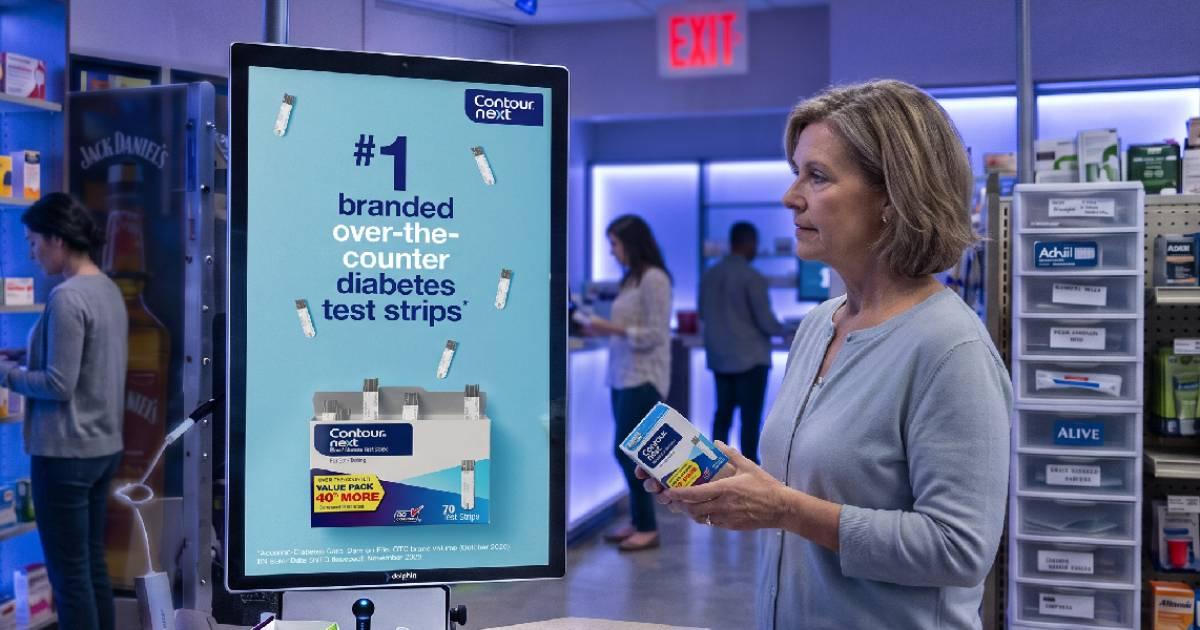
80% of purchase decisions happen in-store - yet most ad budgets chase shoppers online. This blog explores why the grocery aisle, pharmacy shelf, and convenience store checkout are the most powerful - and most underserved - moments in advertising. With the latest DOOH data and insights from Dolphin Retail Media's 6000+ screen network, find out why the new homepage isn't a URL. It's an aisle.
Why the Aisle is the New Homepage: The Case for In-Store DOOH in 2026
*You've optimized your homepage. A/B tested your landing pages. Poured millions into search, social, and streaming ads. But here's the one truth no algorithm can override:*
The most powerful screen your shopper will ever see doesn't have a URL.
It's the screen at the end of the grocery aisle. The one beside the pharmacy counter. The display above the checkout lane glows quietly while your customer reaches for a product and makes a decision that took less than ten seconds.
Welcome to the new homepage.
The Billion-Dollar Blind Spot
Every year, the advertising industry congratulates itself on how sophisticated digital targeting has become. Lookalike audiences. Predictive intent signals. Algorithmic optimization down to the millisecond.
And yet - close to 80% of purchase decisions are still made in-store.
Not on a phone. Not in a browser. Not during a YouTube pre-roll. In a physical store, with a product in hand, surrounded by competing options, and a shopping list running through their head.
The industry has built extraordinary infrastructure to reach people everywhere except the one place that actually drives the sale. That's not a gap in media planning. That's a canyon.
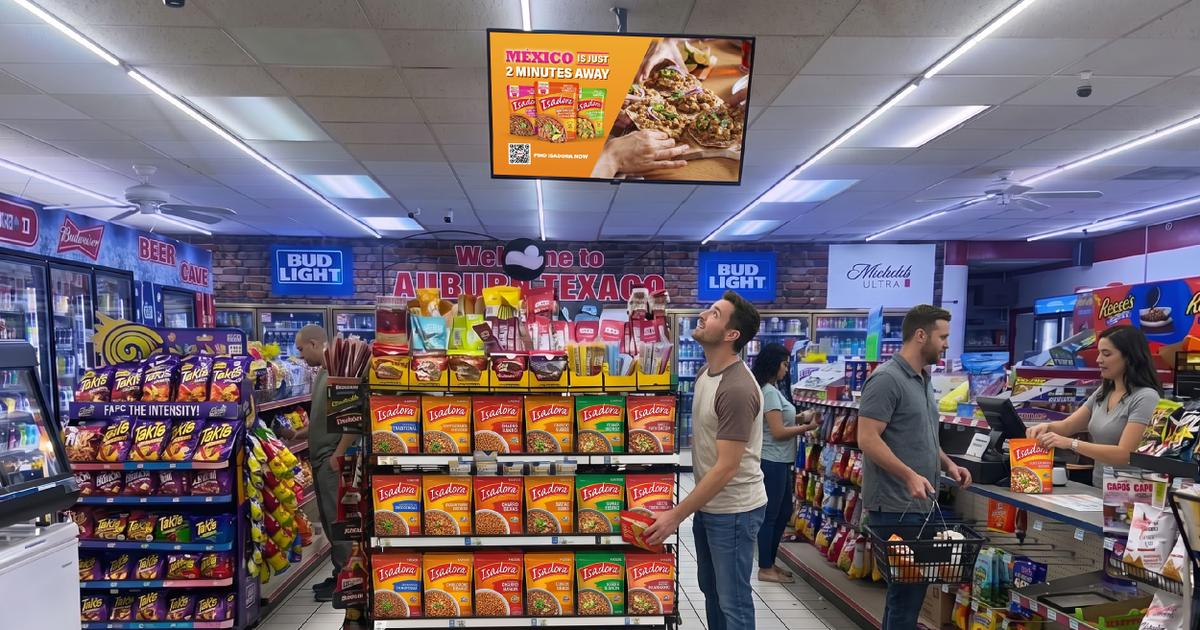
The Shopper Is Already There. Is Your Brand?
Here's something that rarely appears in a digital media deck: Americans take 1.1 billion trips every single day. Four trips, for every person in the country. And 45% of those trips are taken specifically for shopping and errands — not commuting, not leisure. Shopping.
That means every single day, hundreds of millions of people walk through the doors of a convenience store, a grocery store, a pharmacy - already in purchase mode, already carrying intent that no ad targeting system had to manufacture.
This is the context that digital advertising spends billions trying to simulate. In-store DOOH already lives inside it.
The shopper didn't need to be convinced to show up. They're already there. The only question is whether your brand is visible when the decision gets made.
What "High Intent" Really Looks Like
Digital marketers love the phrase "high-intent audience." But let's be precise about what intent actually looks like in practice.
A person searching for "best oat milk brand" on Google has intent. A person standing in the dairy alternative aisle of a grocery store, reaching for a carton, has *purchase-imminent intent*. These are not the same thing. One requires nurturing. The other requires a three-second message and a reason to act.
The average grocery shopper spends 45 minutes in-store across their visit. During that time, they pass through multiple categories, navigate multiple decision moments, and encounter dozens of products competing for their basket. Each of those moments is an opportunity and in-store DOOH screens exist precisely at those moments, not before them and not after.
Think of it this way: a digital ad reaches a person who *might* shop later. An in-store screen reaches a person who is shopping right now.
That distinction is worth billions.
The Industry Is Catching Up - Fast
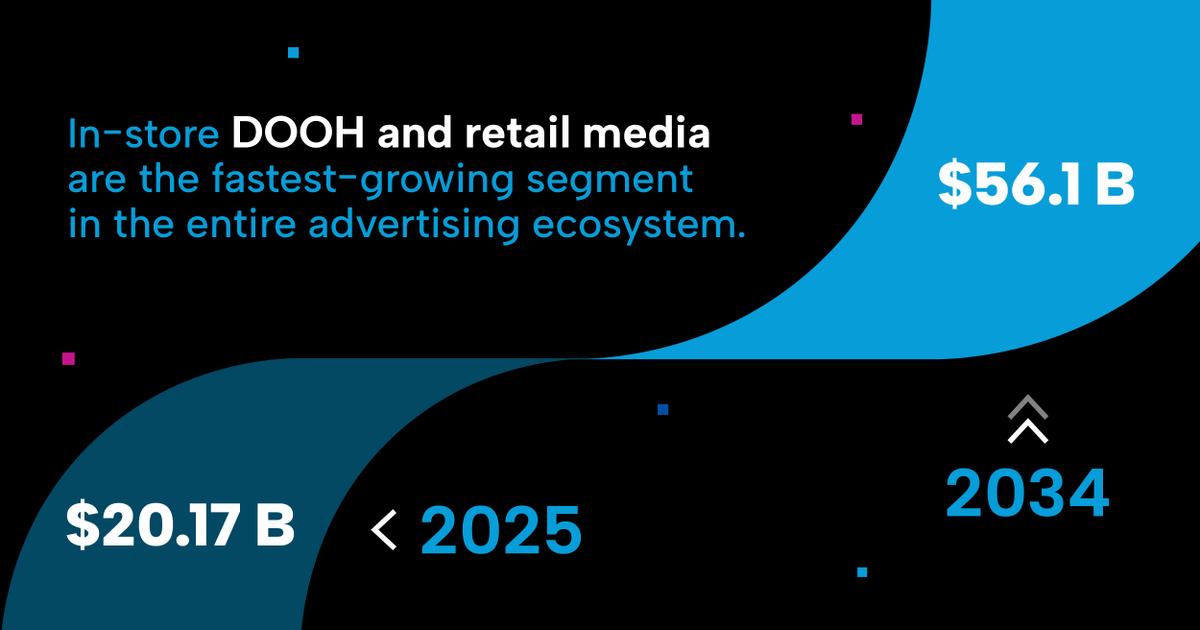
The numbers confirm what instinct already knows. In-store DOOH and retail media aren't emerging trends. They're the fastest-growing segment in the entire advertising ecosystem.
The global DOOH market was valued at $20.17 billion in 2025 and is on track to reach $56.1 billion by 2034 - a compound annual growth rate of 12.09%. In North America, the market hit $6.78 billion in 2025, projected to climb to $7.4 billion in 2026 alone.
Retail media overall grew 17.6% year-over-year in 2025, now accounting for 15.4% of global digital ad spend - and it's projected to overtake social media in total spend within the next two to three years*. The physical extension of retail media into in-store DOOH is where that next wave of growth is being built.
By 2028, DOOH will account for 45.2% of all out-of-home ad spending globally — up from just 22% in 2016 *(eMarketer)*. The channel isn't rising. It's already risen.
The Measurement Era Has Arrived
The old knock on OOH was that you couldn't prove it worked. That objection is now obsolete.
In 2026, in-store DOOH measurement has three mature, independent layers:
Verified Audience Delivery. Geopath — the not-for-profit audience measurement body for US out-of-home — provides independently audited impression counts based on mobility data, demographic layering, and venue-specific dwell time. This isn't estimated reach. It's verified delivery, comparable to the standards television planners have used for decades.
Foot Traffic and Incrementality. Research from OAAA confirms that DOOH campaigns generate an average **foot traffic lift of 10–20%** when measured against a control group. Brands running geo holdout experiments can calculate causal incrementality at every funnel stage — from first exposure through to transaction.
Closed-Loop Sales Attribution. When in-store screen exposure data is paired with first-party retail transaction data, brands can measure the direct impact on sales — not as an assumption, but as attribution. Brands using closed-loop DOOH measurement report significantly stronger confidence in ROI justification and sustained budget commitment *(eMarketer, 2026)*.
The result is a channel that is as measurable as search, but operating in a context search cannot reach. And critically — in-store DOOH is immune to ad blockers, scroll fatigue, and algorithm changes. The screen is on. The shopper is present. The impression is real.
The Creative Rules Have Changed
In-store DOOH demands a different creative discipline. Not harder - different.
The shopper's attention is split across their list, the shelf, the price tag, and whatever their two-year-old is doing three feet away. The creative that wins in this environment isn't the one that tells the longest story. It's the one that lands fastest.
The principles that consistently outperform in the in-store context:
Silence is the default. Retail environments are loud. Any creative that depends on audio to carry the message has already lost half its audience. The visual must work alone.
One claim. One cue. The most effective in-store DOOH creative leads with a single product benefit and a single reason to act - a colour trigger, a price, a seasonal hook. Not a narrative. A nudge.
Context-matched messaging. A pharmacy screen should speak to health. A grocery screen should speak to meal occasions or family. A convenience store screen should speak to the moment — the morning commute, the afternoon snack run, the late-night errand. Generic creative underperforms contextual creative in every study.
Dynamic creative at scale. AI-powered dynamic creative adjustment (DCA) now allows brands to modify in-store messaging in real time based on time of day, local weather, regional inventory, or promotional calendars. A cold and flu brand that increases screen frequency when local pharmacists report rising demand. A beverage brand that switches creative when the temperature crosses 90 degrees. This isn't the future. It's 2026.
The Attention Economy Has a Physical Address
There is an ongoing conversation in advertising about where human attention actually lives in a world of infinite content. The answer, increasingly, is: not where most budgets go.
Social media feeds are saturated. Pre-roll is skipped. Streaming services are launching ad tiers that users immediately learn to ignore. The digital attention economy is experiencing genuine diminishing returns at scale.
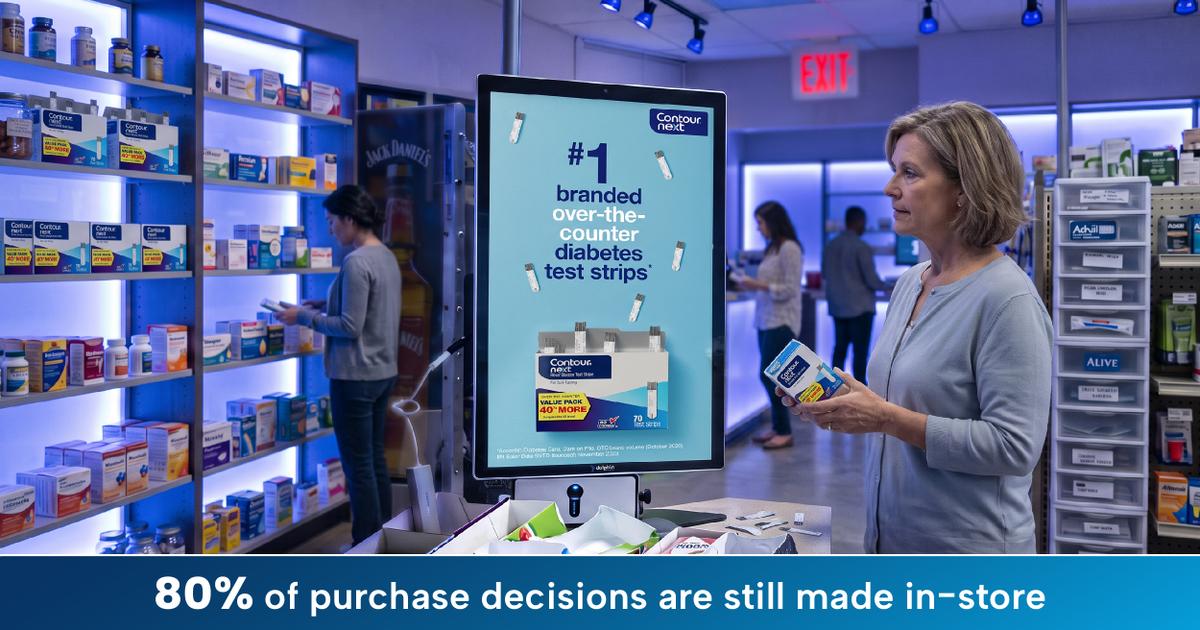
Meanwhile, the physical world - the grocery store, the pharmacy, the corner convenience store - remains one of the most reliable environments for undistracted human attention in advertising. OOH campaigns have consistently demonstrated a 48% higher brand recall rate when paired with mobile, compared to either channel alone . The physical impression anchors the digital one.
There is also something worth naming plainly: in-store advertising is one of the only media environments where the audience *chose to be there*. No one was algorithmically funnelled into a grocery store. They made a deliberate trip, for a deliberate purpose, with money they intend to spend. That's not just reach. That's context.
Where Dolphin Retail Media Comes In
Dolphin Retail Media was built for exactly this moment.
Operating 6000+ digital screens across 150+ DMAs nationwide - embedded inside grocery stores, convenience stores, pharmacies, and dining venues - Dolphin puts brands at the precise point where purchase decisions are made. Not near the store. Not on the way to the store. Inside it, at the moment that matters.
Every week, Dolphin's network delivers 375 million Geopath-verified impressions — zero ad-fraud, third-party audited, and integrated across leading SSPs for seamless programmatic access. That's reach you can trust, in a context that cannot be replicated outside the four walls of the store.
For CPG brands, beverage companies, health and beauty labels, financial services, telecom providers, and any brand that needs to influence the shopper at the moment of decision — Dolphin Retail Media is where the strategy closes.
The aisle is the new homepage.
Dolphin owns the real estate.
References
DPAA. (2025). Omnichannel Decision Makers Study: How Brands Leverage DOOH and In-Store Retail Media. Advertising Week Europe.
eMarketer / Insider Intelligence. (2026). OOH and DOOH Advertising Forecast: Share of Spend and Channel Growth Projections. EMARKETER Retail Media Forecast Update H1 2025.
Fortune Business Insights. (2026). Digital Out-of-Home Advertising Market Size, Share & Industry Analysis.
Geopath. (2026). OOH Audience Measurement: Weekly Impressions and Trip Data.
Nielsen. (2025). OOH and Mobile Advertising: Cross-Channel Brand Recall Study.
OAAA (Out of Home Advertising Association of America). (2026). DOOH Campaign Effectiveness: Foot Traffic Lift Benchmarks.
Advertising Week. (2025, April). DPAA: In-Store Retail Media and DOOH Session, AWEurope 2025.